The Colorado Republican Committee Bylaw Changes and Primary Opt-Out
Two things happened to the Colorado Republican Committee in the spring of 2026: by a consent decree it did not contest, it became bound to opt out of Colorado's semi-open primary for 2028 and beyond; and its governing bylaws were rewritten to match — replacing the membership's 75% opt-out threshold with a simple majority. Day by day, with the documents at each step. Select a date to expand it.
2016 – 2025The opt-out the membership kept declining
Colorado's Proposition 108 (2016) created a semi-open primary in which unaffiliated voters receive both major parties' primary ballots and may return one. A major party may opt out only if 75% of its central committee so votes (C.R.S. § 1-4-702(1)). The CRC sought to opt out roughly every two years from 2017 onward but never reached the 75% supermajority. Documented Colorado Politics
- Apr 6, 2024 — the State Assembly (Pueblo, 2,143 delegates) directs opt-out "in perpetuity" from 2026.
- Sep 27, 2025 — the CRC votes by majority, not 75%, to opt out of the 2026 primary.
March 31, 2026A federal court strikes the 75% threshold
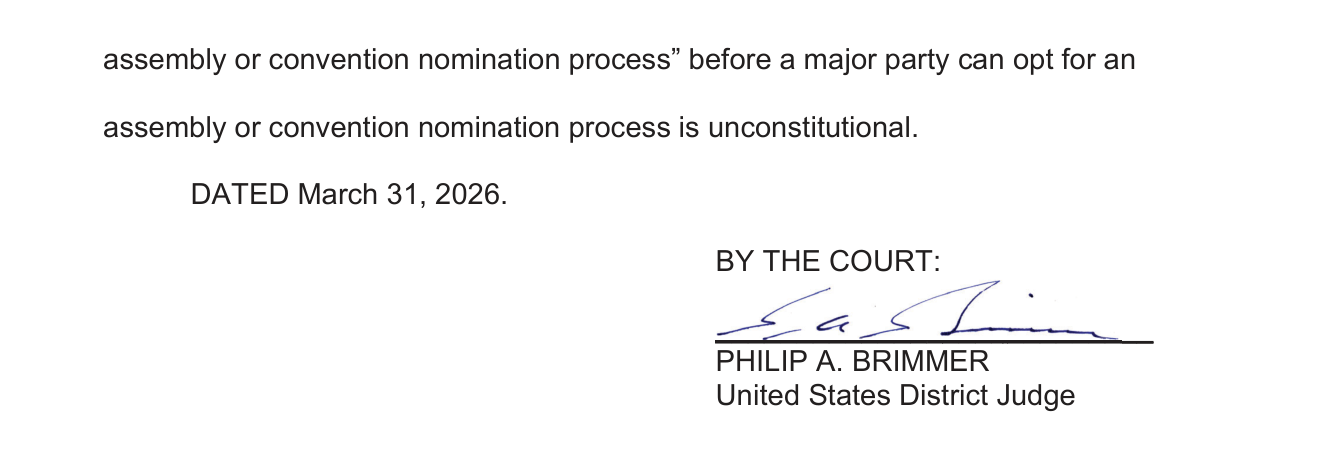
In Colorado Republican Party v. Griswold (No. 1:23-cv-01948, D. Colo.), Chief Judge Philip A. Brimmer holds the 75% threshold an unconstitutional severe burden on the party's associational rights; the ruling did not set a replacement threshold. On April 28 he denies the party's emergency motion to bar unaffiliated voters from the June 2026 primary. Documented
April 17, 2026The chair resigns; the vice chair takes over
Chair Brita Horn's resignation takes effect. The committee's vice chair, Eric Grossman, becomes acting chair for the interim before a new chair is elected. Documented press
April 21, 2026A member sues the committee
Timothy Leonard, a CRC member, files a "forthwith petition" (C.R.S. § 1-1-113) asking the court to compel the CRC to opt out. The petition argues the 2024 Assembly directed opt-out; the federal ruling killed the 75% threshold; the chairman's refusal to notify the Secretary of State is a breach of a ministerial duty; and the Assembly is the "supreme governing body" whose determinations "shall be final" (C.R.S. § 1-3-106). Documented
May 13, 2026The committee does not contest; it settles
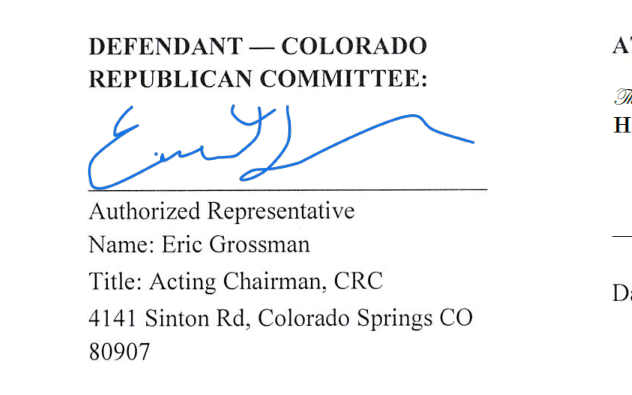
On May 13 (filed 8:08 PM), the defendant files its entry of appearance, a signed Stipulated Settlement Agreement, an Unopposed Motion for Approval of the settlement and entry of a consent order, and two proposed orders. No answer, no discovery, no contested hearing. The motion is the CRC's own counsel moving, unopposed, to approve the settlement the committee had signed. The agreement is signed by Timothy Leonard (Pro Se), by Eric Grossman as "Acting Chairman, CRC," and by David Pigott (Hampton & Pigott). Documented
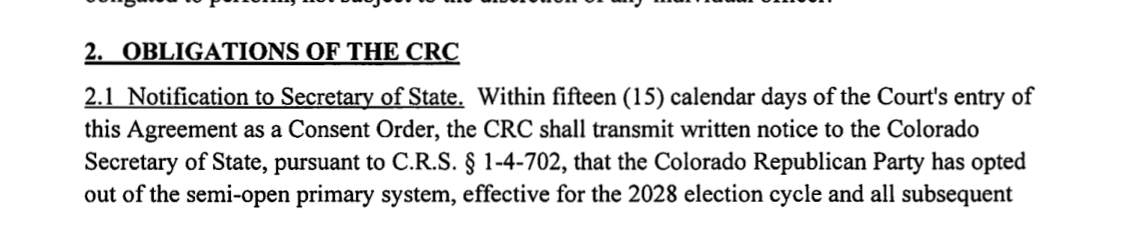
What the consent order binds the party to:
- Notice to the Secretary of State that the party has opted out, effective the 2028 cycle and all subsequent cycles.
- The opt-out standard changed to "a majority vote of the State Central Committee," displacing the 75% threshold.
- Six bylaw amendments to be adopted within 60 days.
- Mandamus compelling the "ministerial" notice; the Chairman certifies compliance under penalty of perjury (§5.2).
- The court retains jurisdiction through Dec 31, 2028; a Special Master may act in place of a noncompliant officer; post-2028 disputes go to binding arbitration (§5.6).
- Any officer who "knowingly interferes" may be held in individual contempt of court (§5.8).
- Claims "DISMISSED WITHOUT PREJUDICE"; the Consent Order "constitutes a FINAL JUDGMENT ON THE MERITS."
May 14, 2026The court enters the consent order — final judgment
The court entered the consent order the day after it was filed. Rather than sign the blank signature line on the proposed order, District Court Judge David Scott Prince issued his own order (file-stamped May 14, 2026, 1:50 p.m.): "The motion/proposed order attached hereto: ACTION TAKEN. The attached is entered by agreement of the parties." Documented entered order
The entered Consent Order declares:
- the 2024 Assembly's April 6, 2024 Opt-Out Directive is "a valid, final, and binding determination under C.R.S. § 1-3-106";
- "the three-fourths (75%) threshold in C.R.S. § 1-4-702(1) is unconstitutional as applied to the Colorado Republican Party";
- "a majority vote of the [CRC] is the constitutionally permissible opt-out standard";
- the 2024 Assembly determination, made under CRC Bylaws Art. XIII §H and C.R.S. § 1-3-106, "survives adjournment and binds the CRC" unless rescinded by a later Assembly through a hand-counted paper ballot;
- "notification to the Secretary of State is a ministerial, non-discretionary duty."
And it orders: the CRC to notify the Secretary of State within ten days that the party has opted out of the semi-open primary for 2028 "and all subsequent cycles"; the court retains jurisdiction through Dec. 31, 2028 (later disputes to binding arbitration); all claims "DISMISSED WITHOUT PREJUDICE"; and the order "constitutes a FINAL JUDGMENT ON THE MERITS." Documented
The order states on its face that it was "entered by agreement of the parties." The declarations — including that a state statute's voting threshold is unconstitutional as applied — were entered on the parties' stipulation, following the unopposed motion, without a contested hearing. The Secretary of State and the General Assembly were not parties to the case. Documented
May 30, 2026Appointments, a new chair, and revised bylaws
8:48 a.m. — the acting chair names his committees. In an email to the SCC membership, Grossman makes "strategic appointments under authority as the acting Chairman": Documented party-wide email
- Assistant Treasurer: David Bjorklund
- Bylaws Committee: James Peabody (chair), Keith Maines, Dan Brown, Brad Collins, Shawn Hegarty
- Legal Affairs Committee: Ken Degraaf (chair), Chuck Bonniwell, Ben Nicholas, Brenda King, Tim Leonard, Dave Williams
The plaintiff, Tim Leonard, is named to the Legal Affairs Committee — 17 days after the settlement — alongside former chair Dave Williams.
The State Central Committee meets and elects a new chair — Craig Steiner. Documented meeting recording
The bylaws appear in a revised version dated May 30 that conforms to the decree — replacing the 75% opt-out threshold with a simple majority:
The bylaw changes, side by side

The public recording of the May 30 meeting contains no motion, second, or vote to adopt or amend the bylaws — the recorded business is credentials and the chairman election. (The audio is imperfect; no adoption motion appears in it.) The amendment text was created by the May 13 settlement; the revision is dated May 30 — 17 days — so it could not have met the bylaws' own requirement of a two-thirds vote with the text in a call mailed at least 30 days before the meeting. Documented
Section A. Amendment: "These bylaws may be amended at any meeting by a two-thirds vote of members present in person or by proxy and voting, provided that the proposed amendment was first submitted to the Bylaws Committee and included in the official call mailed no fewer than thirty days before that meeting."
Section B. Effect of Inadequate Notice: "If previous notice was not given in the call, unanimous consent of all CRC members present, in person or by proxy, must be obtained before any amendment may be offered."
June 8 – 10, 2026The settlement surfaces
No media coverage of the settlement has been located. It surfaced through internal disclosures by named party members — Thomas J. Scovill (email, Jun 8) and Darrel Phelan (video and an SCC notice, Jun 10). They characterized it as a "conspiracy" and a "fraud." Documented disclosures
June 2026The acting chair defends the settlement publicly
A signed public letter from Eric Grossman, Vice Chairman, circulated on Facebook (reproduced in a post by CRC member Raymond Garcia). In it, Grossman states that "Following the court-approved settlement in Leonard v. Colorado Republican Committee on 5.14.26, the Colorado Republican Party has formally committed to notifying the Secretary of State of its intent to opt out of the open primary for the 2028 election cycle." He writes that "Over Memorial Day Weekend, that notification was delivered, acknowledged, and the bylaw changes were ordered," and that "The Order was entered. Compliance began." Reported public statement
Grossman ties the settlement to the April 11, 2026 State Assembly vote "to direct immediate action regarding the open primary issue," and offers a legal rationale: citing a parliamentarian memorandum, he writes that "State constitutions, statutes, and valid court orders supersede organizational bylaws," so "implementation is not merely a matter of preference or politics. It is a matter of compliance." He states the settlement "does not change the rules for 2026" but "establishes a definitive path for 2028." The characterizations are Grossman's; the Secretary-of-State transmittal he describes remains to be independently verified, and no public response from the Secretary of State is known. Reported
The people named in the record
Open questions & remaining records
- Amendment notice & vote — the ≥30-day-with-text requirement could not be satisfied; the public meeting shows no two-thirds vote. The official SCC call/minutes would be definitive. Unverified
- Authority to bind — the bylaw text cuts both ways on an acting chair's authority; for the SCC to weigh.
- Statute vs. bylaw — the revised bylaws grant the assembly a standing supremacy; the statutes vest the controlling power in the central committee. The entered consent order declared the bylaw/assembly reading valid and binding, by stipulation of the parties. The texts, and what the court did with them, are set out below.
- Was the opt-out filed? — Grossman's June public letter states the Secretary of State notification "was delivered, acknowledged" over Memorial Day Weekend. That is his public account; a CORA response from the Secretary of State would confirm the filing independently.
Statute — C.R.S. § 1-4-702: the opt-out requires a vote of "three-fourths [75%] of the total membership of the party's state central committee."
Statute — C.R.S. § 1-3-106: the state central committee "has full power to pass upon and determine all controversies… All determinations upon the part of the state central committee shall be final." The state convention holds those powers only "from the time the state convention… convenes until… final adjournment… but not otherwise."
Revised bylaw — Art. XIII §H: retitled "Supremacy of State Assembly and/or Convention," providing that Assembly directives "shall remain valid, final, and binding."
The question: the statutes vest the controlling power in the central committee and give the convention authority only while it is in session; the revised bylaws grant the assembly a standing supremacy.
What the court did with it: the entered consent order resolves this between the parties — it declares (on their stipulation) that the 2024 Assembly determination, made under Art. XIII §H and § 1-3-106, "survives adjournment and binds the CRC," and that the 75% threshold in § 1-4-702(1) is "unconstitutional as applied." The order states it was "entered by agreement of the parties." The Secretary of State and the General Assembly were not parties to the case.
Records still being obtained: the Secretary of State opt-out filing (Grossman's public letter states it was transmitted over Memorial Day Weekend, and the entered order compelled it within ten days — a CORA response would confirm independently); the official May 30 SCC call/minutes.
Statutes & legislation
This is a living record. It is updated as documents are obtained and verified — check back or refresh for the current version.
| v1.3 | June 11, 2026 | Title updated to name both the bylaw changes and the primary opt-out. |
| v1.2 | June 11, 2026 | Lead revised to foreground both the bylaw revision and the primary opt-out, with the 75%–to–majority threshold change surfaced up front. Readability pass — the semi-open-primary ballot description made precise, the chair's resignation effective-date clarified, the federal ruling noted as setting no replacement threshold, and the verification wording on the public letter tightened. |
| v1.1 | June 11, 2026 | Added the entered Consent Order (District Court Judge David Scott Prince, file-stamped May 14, 2026). Updated the May 14 entry to reflect final judgment and the court's declarations; revised the statute-and-bylaw analysis; removed the entered order from the open-records list. |
| v1.0 | June 11, 2026 | Initial publication — the record assembled from court filings, party records, the governing bylaws, the cited statutes, named disclosures, and the acting chair's public letter. |